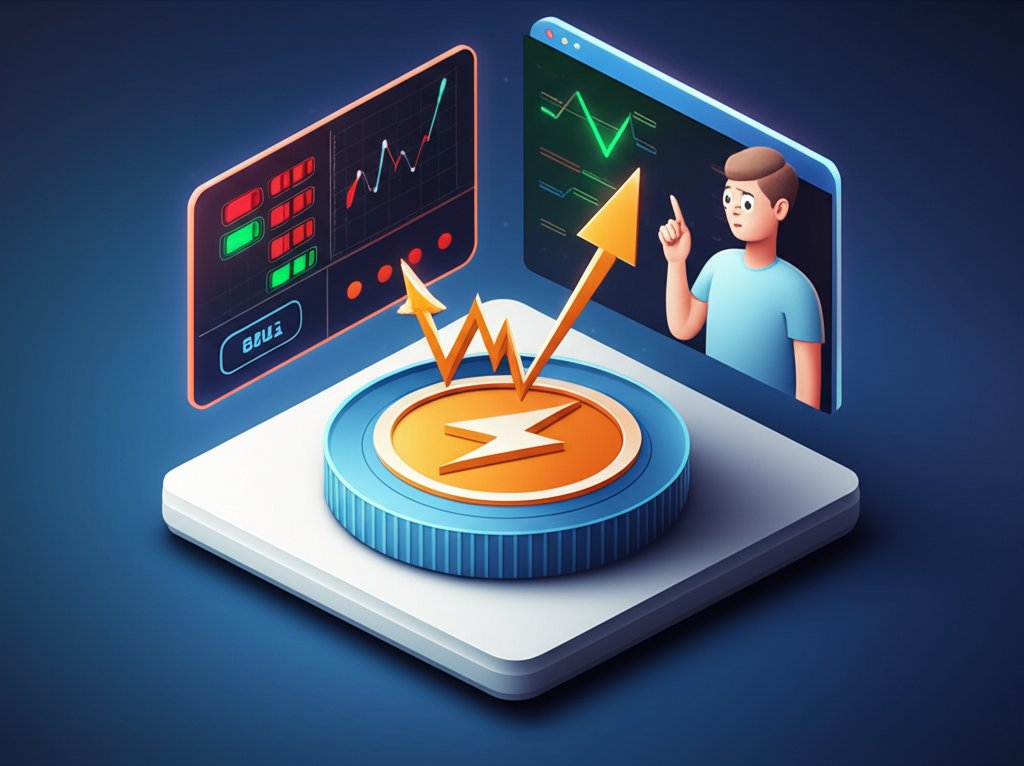
The world of cryptocurrency is a high-stakes arena, and few corners are as exhilarating—or as nerve-wracking—as the market for the most volatile cryptos. If you’re a trader seeking rapid price swings and the potential for outsized returns, these assets are your playground. But be warned: with great opportunity comes equally great risk. This guide will equip you with the knowledge, strategies, and cautionary tales needed to navigate this thrilling, unpredictable landscape.
At a Glance: Key Takeaways for Trading Volatile Cryptos
- Volatility Defined: Rapid, significant price changes (often >10% daily), driven by hype, news, tech updates, and market sentiment.
- Higher Risk, Higher Reward: Volatile cryptos offer immense profit potential but also significant downside.
- Small Caps Lead the Way: Meme coins and newer tokens with smaller market capitalizations are typically the most volatile.
- Tools for Identification: Monitor "Gainers & Losers" lists, look for surging trading volume, and use technical indicators like Bollinger Bands and Average True Range (ATR).
- Risk Management is Crucial: Always use stop-loss orders, define take-profit targets, and never invest more than you can afford to lose.
- Diversify Wisely: Balance volatile altcoins with stable large-cap assets and stablecoins.
- Timing Matters: Crypto market volatility often peaks between midnight and 1 AM UTC.
What Makes a Crypto So Wild? Understanding Volatility
Volatility isn't just a buzzword; it's a measure of how much an asset's price varies over time. In the crypto world, this variation can be extreme, leading to daily price swings of 10% or more. What fuels these dramatic movements?
Think of it like a highly caffeinated crowd at a concert:
- Social Media Hype: A single tweet from an influencer or a viral meme can send a coin soaring or plummeting.
- Technological Updates: New features, roadmap achievements, or even major bug fixes can dramatically impact investor sentiment.
- Market Sentiment & News: Broad market trends, regulatory announcements, or macroeconomic news can ripple through the crypto space, hitting smaller, less established coins hardest.
- Low Market Capitalization: Smaller coins have fewer tokens in circulation and less liquidity. This means a relatively small amount of buying or selling pressure can have a massive impact on their price. Large investors can move these markets with ease.
- Speculative Nature: Many volatile cryptos, especially meme coins, have little to no underlying utility. Their value is almost entirely driven by speculation and community enthusiasm, making them extremely susceptible to sudden shifts in sentiment.
Understanding these drivers is your first step toward anticipating—and potentially profiting from—the market's unpredictable gyrations.
The Double-Edged Sword: Why Engage with Volatile Cryptos?
For seasoned traders and those with a high-risk tolerance, volatile cryptocurrencies represent an irresistible challenge. The allure is simple: rapid price movements create opportunities for substantial gains in a short timeframe. Imagine buying a coin that rockets 50% in a single day—or even hours. This kind of explosive growth is rarely seen in traditional markets.
However, the flip side is equally stark. These same rapid movements can just as easily wipe out a significant portion of your capital if the trade goes against you. What goes up quickly can come down even faster. Trading these assets requires not just a solid strategy but also ironclad discipline and emotional control.
Identifying Your Next High-Octane Trade
Finding the next volatile gem requires a keen eye and the right tools. You're looking for assets that are either already experiencing significant movement or are poised to do so.
Market Cap Matters: Where to Hunt
The general rule of thumb: smaller market caps equal higher potential volatility.
- Meme Coins: Assets like Dogecoin (DOGE), Shiba Inu (SHIB), Bonk (BONK), and Dogwifhat (WIF) are poster children for volatility. Their value is often driven by viral trends, celebrity endorsements, and community fervor rather than fundamental utility.
- Newer Tokens & Presales: Freshly launched projects or those still in their presale phase (like some listed in our context) often have minuscule market caps. While they offer early entry and potentially massive growth, they also carry the highest risk of failure or becoming "rug pulls."
- Emerging Altcoins: Beyond meme coins, many newer altcoins aiming to solve specific blockchain problems can also be highly volatile as they gain traction or face challenges.
Reading the Market's Tea Leaves: Essential Tools
You don't need a crystal ball, but you do need reliable data.
- "Gainers & Losers" Lists: Most crypto exchanges and data sites (like CoinMarketCap or CoinGecko) feature daily "top gainers" and "top losers" lists. These are invaluable for quickly spotting coins experiencing significant price action. A sudden spike in trading volume accompanying these movements is often a strong indicator.
- Price History Analysis: Look at historical charts on platforms like CoinMarketCap. Observe daily, weekly, and monthly percentage changes. Coins consistently moving 10% or more within a day are clearly in the volatile camp.
- Volume Spikes: A sudden surge in trading volume often precedes or accompanies significant price movement. High volume indicates strong interest from buyers and sellers, which fuels volatility.
- Social Listening: Keep an ear to the ground on crypto Twitter, Telegram groups, and Reddit. While prone to hype, these platforms can be early indicators of sentiment shifts that impact highly volatile assets.
Technical Indicators for Pinpointing Volatility
Beyond fundamental analysis and news, technical indicators can provide quantifiable insights into market momentum and volatility.
- Bollinger Bands: These bands expand and contract around a moving average. When they widen significantly, it signals increased volatility. Price breaking out of the bands can indicate strong trend continuation or reversal.
- Average True Range (ATR): ATR measures market volatility by calculating the average range between high and low prices over a specific period. A rising ATR suggests increasing volatility, making it a great tool for determining potential price swings and setting stop-loss levels.
- Keltner Channels: Similar to Bollinger Bands, Keltner Channels use Average True Range to create dynamic price envelopes. When prices consistently close outside these channels, it can indicate a strong directional move and heightened volatility.
By combining these methods, you can systematically identify cryptos poised for significant movement, helping you to pinpoint High Volatility Crypto Picks with greater confidence.
A Closer Look: Current Highly Volatile Cryptos
The crypto market is dynamic, and the list of "most volatile" changes constantly. Based on recent trends and market characteristics, here are types of cryptocurrencies that often exhibit high volatility. Disclaimer: This is not financial advice. Do your own research, and understand that past performance is not indicative of future results.
Established (But Still Wild) Altcoins
Even larger-cap altcoins can be surprisingly volatile compared to traditional assets. These often have solid use cases but can still react sharply to market news, network updates, or broader crypto sentiment.
- Solana (SOL): A high-performance blockchain, SOL has shown immense growth and significant corrections. Its speed and low transaction fees (around $0.00025 per transaction) make it popular, but its price can swing wildly with network developments or outages.
- Dogecoin (DOGE) & Shiba Inu (SHIB): The original meme coins. While they have large market caps now, their prices are still heavily influenced by celebrity tweets, social media trends, and overall speculative sentiment.
- Axie Infinity (AXS): The governance token for the popular Play-to-Earn (P2E) game, its value is tied to the game's popularity and broader NFT/gaming trends.
- Lido DAO (LDO): A liquid staking solution for Ethereum, LDO's price can react to ETH staking trends, regulatory news, and competition in the DeFi space.
- Fantom (FTM), ApeCoin (APE), The Graph (GRT), Quant (QNT), Algorand (ALGO), Filecoin (FIL), Stellar (XLM), Ripple (XRP), Bitcoin Cash (BCH), Litecoin (LTC), Dash (DASH), Bitcoin Gold (BTG): These represent a mix of smart contract platforms, data indexing protocols, payment networks, and Bitcoin forks. Each has its unique drivers, but all can experience considerable volatility due to ecosystem developments, competition, or overall market sentiment shifts. For those trading on major exchanges, understanding Coinbases most volatile crypto can be particularly useful.
Emerging & Meme Coins (Higher Risk, Higher Potential)
This category includes newer projects, presale tokens, and highly speculative meme coins. They often lack fundamental utility but can offer exponential gains—and losses—due to their low market caps and reliance on hype.
- Bitcoin Hyper ($HYPER): Positioned as a Layer 2 scaling solution for Bitcoin using Solana Virtual Machine (SVM). Its presale offered staking rewards, indicating its early-stage, high-potential, and high-risk nature.
- Maxi Doge (MAXI): A meme coin with a significant portion of its supply allocated to community support and marketing. Presales often see massive staking APYs, highlighting the early speculative interest.
- PepeNode ($PEPENODE): An Ethereum-based play-to-earn game with a virtual mining concept and deflationary tokenomics. P2E tokens are often highly volatile, tied to game adoption and token burn mechanisms.
- Snorter Bot ($SNORT): A Solana-based meme coin that also functions as a "sniper" tool for other tokens, integrated with Telegram for trading alerts. Utility-driven meme coins often find a niche but remain speculative.
- Best Wallet Token ($BEST): A utility and governance token for a Web3 wallet. Wallet tokens can be volatile, as their value is linked to platform adoption and usage.
- SUBBD ($SUBBD): A token linked to a pay-per-view content platform using AI tools. Such projects blend tech with content, creating a unique speculative profile.
- Dogwifhat (WIF), Bonk (BONK), Brett (BRETT): These are recent meme coin sensations, particularly on Solana and Base networks. They typically have no inherent utility, with their value purely driven by community hype, virality, and speculative trading. Their meteoric rises and sharp corrections are textbook examples of extreme volatility.
Strategies for Taming the Wild West: Trading Volatile Cryptos Safely
Trading volatile cryptos is not for the faint of heart. It demands a robust strategy, strict risk management, and emotional discipline.
Short-Term Tactics: Riding the Waves
The rapid price swings make these assets ideal for short-term trading styles.
- Scalping: This involves making numerous small trades throughout the day, holding positions for minutes or even seconds, to capture tiny price discrepancies. It requires intense focus, quick execution, and sophisticated tools.
- Day Trading: Opening and closing positions within the same trading day to profit from intraday price movements. Day traders avoid holding positions overnight to sidestep unexpected news or market shifts.
- Swing Trading: Holding assets for a few days or weeks to capture larger "swings" in price. This involves identifying potential trends and riding them for a portion of their duration.
Risk Management is Non-Negotiable: Your Shield
This is arguably the most crucial aspect of trading volatile assets. Without it, you're just gambling.
- Always Use Stop-Loss Orders: This is your absolute must-have. A stop-loss order automatically sells your asset if its price falls below a predetermined level, limiting your potential losses. For example, if you buy a coin at $1 and set a stop-loss at $0.90, your maximum loss on that trade is 10%.
- Define Take-Profit Orders: Just as important as limiting losses is locking in gains. A take-profit order automatically sells your asset once it reaches a predetermined profit target. This prevents greed from turning a profitable trade into a losing one if the price reverses.
- Position Sizing: Never allocate more than a small percentage of your total trading capital to any single volatile trade. A common rule is to risk no more than 1-2% of your entire portfolio on one trade. If you have $10,000, that's $100-$200 per trade. This way, a single bad trade won't decimate your funds.
- Diversification: Don't put all your eggs in one volatile basket. A balanced portfolio might include a mix of:
- Stable Large-Cap Assets: Bitcoin (BTC) and Ethereum (ETH) as a foundation.
- Moderately Volatile Altcoins: Established projects with utility.
- Highly Volatile Altcoins/Meme Coins: Your high-risk, high-reward plays.
- Stablecoins: Tether (USDT), USD Coin (USDC) to provide liquidity and a safe haven during extreme market downturns.
- Never Use More Leverage Than You Can Afford to Lose: Leverage amplifies both gains and losses. While it can make you rich quickly, it can also liquidate your entire position with a small adverse price movement. If you're new to volatile assets, avoid leverage altogether.
- Stay Informed, But Don't Overreact: Hype and fear (FOMO/FUD) drive volatile markets. While staying updated is essential, avoid making impulsive decisions based on every piece of news or social media chatter. Stick to your trading plan.
- Market Timing: While difficult to perfect, data suggests crypto market volatility tends to be highest between midnight and 1 AM UTC. This could be due to lower trading volumes in some regions, making prices more susceptible to larger orders. Savvy traders might adjust their monitoring or trading activity around these hours.
Common Mistakes and How to Avoid Them
- Chasing Pumps: Buying into a coin that has already surged dramatically, only to see it correct sharply. Antidote: Set entry criteria before a pump, not during it.
- Ignoring Stop-Losses: Believing a losing trade will eventually recover, leading to significantly larger losses. Antidote: Treat your stop-loss as sacred. Once it's hit, the trade is over.
- Over-Leveraging: Using too much borrowed capital, leading to swift liquidations. Antidote: Use leverage sparingly, if at all, especially with volatile assets.
- Lack of Research: Investing based purely on hype or social media recommendations without understanding the project (or lack thereof). Antidote: Always do your own due diligence, no matter how exciting a coin appears.
- Emotional Trading: Letting fear, greed, or impatience dictate your decisions. Antidote: Develop a clear trading plan and stick to it, regardless of market emotions.
Frequently Asked Questions (FAQs)
Are volatile cryptos always risky?
Yes, by definition, higher volatility means higher risk. While they offer the potential for quick profits, they also carry the significant risk of rapid and substantial losses. It's a fundamental trade-off.
Can I get rich quickly trading these coins?
It's possible to make significant gains quickly, but it's equally possible to lose your capital just as fast. The "get rich quick" mentality often leads to poor decision-making and substantial losses. A disciplined approach with proper risk management is key, not speed.
How often should I check my portfolio when trading volatile cryptos?
For short-term strategies like scalping or day trading, you might be monitoring charts almost constantly during your trading sessions. For swing trading, checking multiple times a day might suffice. The key is to be present when your trades are active and to have stop-losses in place to protect you when you're not.
What's the best exchange for trading highly volatile cryptos?
The "best" exchange depends on your location, preferred features, and the specific coins you want to trade. Major exchanges like Binance, Kraken, and Coinbase generally offer a wide range of altcoins and robust trading tools. Decentralized exchanges (DEXs) are often where newer, more volatile tokens first appear. Always prioritize exchanges with strong security, good liquidity for your chosen assets, and reasonable fees.
Your Next Move: Mastering the Volatility Game
Trading the most volatile cryptos is not for everyone. It requires a specific mindset, a solid understanding of market mechanics, and a steadfast commitment to risk management. If you're prepared for the rollercoaster ride and willing to put in the work, the potential rewards can be compelling.
Start by educating yourself further, perhaps by diving deeper into specific technical indicators or backtesting strategies. Begin with a small amount of capital you're comfortable losing, and gradually increase your exposure as you gain experience and confidence. Remember, the goal isn't just to make big trades, but to make smart trades that allow you to survive—and thrive—in the exciting, yet perilous, world of crypto volatility.