
Turning a modest capital into a formidable market position, potentially multiplying your profits far beyond what your initial investment alone could achieve – this isn't magic. It's the strategic deployment of leverage crypto cash. While it offers an exhilarating path to amplify trade returns in the volatile crypto markets, it's also a high-stakes game. Understanding how to wield this powerful tool responsibly is the absolute key to unlocking its immense potential without succumbing to its inherent risks.
At a Glance: Leveraging Crypto Cash Smartly
- Magnify Market Exposure: Understand how a small deposit can control a much larger trade value.
- Amplify Returns (and Risks): Learn the dual nature of leverage, boosting potential gains but also losses.
- Guard Against Liquidation: Discover essential risk management techniques like stop-loss orders.
- Platform Selection Smarts: Identify critical factors when choosing a crypto leverage trading platform.
- Step-by-Step Execution: Walk through the practical process of making your first leveraged crypto trade.
Demystifying Leverage Crypto Cash: Your Supercharger for Market Exposure
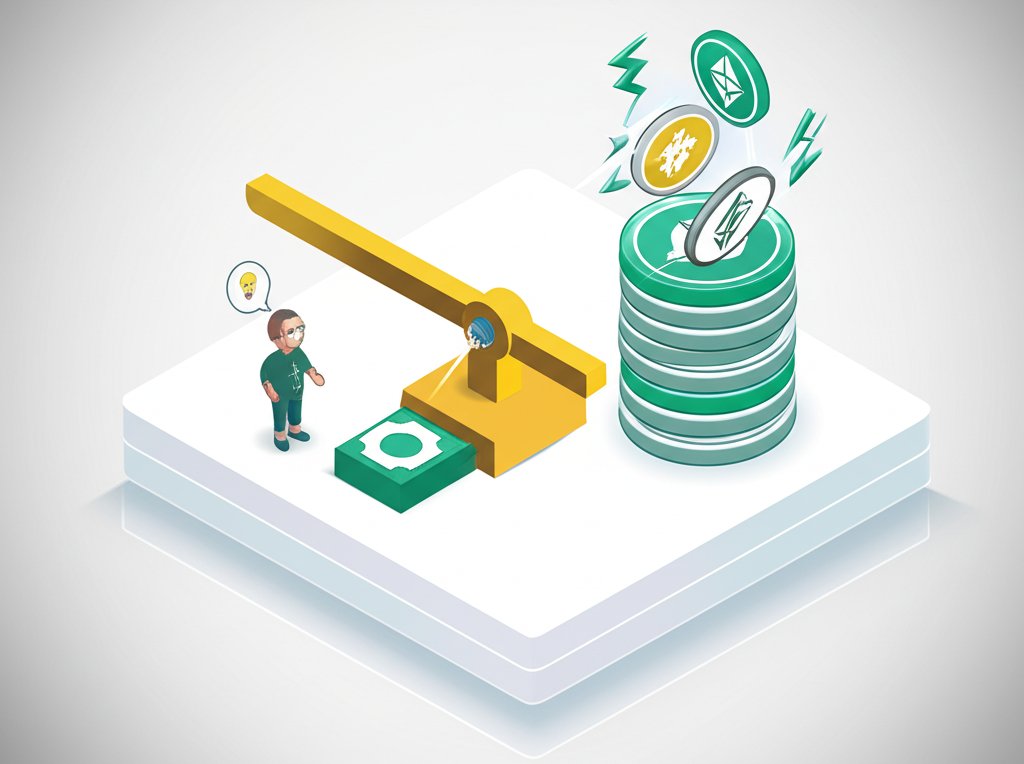
At its core, leverage crypto cash refers to using borrowed funds to increase your trading position beyond what your actual capital would allow. Think of it like a micro-loan for your trade: you put down a small percentage of the total trade value (your "margin"), and the exchange covers the rest. This amplifies your market exposure, meaning even small price movements in the underlying crypto asset can translate into significant percentage gains or losses on your initial margin.
For instance, if you stake $100 with 10x leverage, you effectively control a $1,000 position in the market. Your $100 acts as a 10% margin requirement for that $1,000 trade. These trades typically occur through derivative products like futures (perpetual or delivery contracts), allowing you to speculate on price movements without directly owning the underlying crypto asset. It’s a powerful mechanism, transforming a humble investment into a substantial market presence.
The Allure of Amplified Gains: Why Traders Embrace Leverage

The primary draw of leverage crypto cash is its ability to magnify profit potential. Here’s why seasoned (and aspiring) traders find it compelling:
- Maximize Capital Efficiency: You don't need a huge war chest to participate significantly in the market. With leverage, a relatively small amount of capital can open a much larger position, freeing up other funds for diversification or different strategies. For instance, platforms like CoinFutures require as little as 0.1% margin for high leverage.
- Exponential Profit Potential: When the market moves in your favor, leverage can turn a modest percentage gain into an outsized return on your initial margin. A 5% upward movement in Bitcoin, for example, could become a 50% return on your staked capital if you're using 10x leverage.
- Flexibility with Short-Selling: Leverage allows you to profit from price declines. By "shorting" an asset, you bet that its price will fall, borrowing and selling it now with the intention of buying it back later at a lower price to return the borrowed amount, pocketing the difference. This is crucial for navigating bear markets or hedging against existing holdings.
- Hedging Opportunities: Traders can use leverage to hedge their existing spot holdings. If you own Bitcoin and anticipate a temporary dip, you could open a small leveraged short position to offset potential losses on your spot assets. If the price falls, your short position profits, balancing out the loss on your long-term holdings.
This potential for enhanced returns and strategic flexibility makes leverage an attractive tool for those aiming to make their capital work harder in the fast-paced crypto landscape.
Navigating the High-Wire Act: The Risks of Leverage Crypto Cash
While the upside is clear, the risks associated with leverage crypto cash are equally profound and demand meticulous attention. This isn't just about losing your initial stake; it's about the speed and certainty of those losses if not managed correctly.
- The Specter of Liquidation: This is the most critical risk. Liquidation occurs when your leveraged position's value drops to a certain point, typically below your initial margin. The exchange automatically closes your position to prevent you from losing more than your staked funds, resulting in the complete loss of your initial investment (and sometimes more if not using isolated margin or linear contracts). The higher the leverage, the smaller the price movement required to trigger liquidation. For example, 500x leverage means a mere 0.2% adverse price move can wipe out your position.
- Volatility as a Double-Edged Sword: Crypto markets are notoriously volatile. While this can lead to rapid gains with leverage, it can just as quickly lead to rapid, magnified losses. A sudden market swing against your position can lead to liquidation in moments.
- Funding Rates and Fees: Beyond standard trading commissions (maker/taker fees), leveraged positions, especially perpetual futures, often incur "funding rates." These are periodic payments exchanged between long and short traders to keep the perpetual contract price pegged to the spot price. Funding rates can be positive or negative, adding an unpredictable cost or benefit that can erode profits or even contribute to losses over time.
- Complexity of Derivatives: Leveraged trading typically involves derivatives, which are more complex than simply buying and holding crypto. Understanding contract specifications, margin requirements, maintenance margin, and liquidation thresholds is crucial.
Successfully navigating leveraged trading requires active market monitoring, a deep understanding of these risks, and a disciplined approach to risk management.
Choosing Your Arena: Platforms for Leverage Crypto Cash Trading
The platform you choose for leverage crypto cash trading is as crucial as your trading strategy itself. They vary widely in terms of maximum leverage, fee structures, available assets, regulatory compliance, and user experience.
When evaluating potential platforms, consider these critical decision points:
- Leverage Limits: Platforms offer a vast range. Coinbase, aimed at US retail traders, offers a conservative 10x. By contrast, CoinFutures provides up to 1000x, and others like MEXC and BTCC go up to 500x. Higher leverage means higher risk but also higher potential returns.
- Fee Structures: Look closely at maker and taker fees. MEXC, for instance, has competitive fees starting at 0.04% for takers, while Gemini's taker fees start higher at 0.07%. Also, factor in funding rates for perpetual contracts, which can significantly impact long-term positions.
- Asset Variety: Some platforms specialize in major pairs like BTC and ETH, while others, like MEXC and BYDFi, offer hundreds of altcoin futures markets. Your preferred assets will dictate your platform choice.
- Regulatory Status & KYC: Regulatory compliance is paramount, especially for US users. Platforms like BYDFi (FinCEN registered), BTCC (licensed in US/Canada/Europe), Coinbase (CFTC-approved), Kraken (CFTC-approved), and Gemini (NYSDFS regulated) cater to the US market. Many popular global exchanges (Binance, Bybit, MEXC, Margex, Phemex) are not available to US users for derivatives or require KYC verification, which some traders prefer to avoid. PrimeXBT, regulated by ASIC, is open to US users for some services.
- User Interface & Features: Beginner-friendly platforms might offer simulated trading (like CoinFutures), while more advanced traders might seek sophisticated charting tools, API access, and diverse order types.
For a comprehensive comparison and deeper dive into the specific features, pros, and cons of these and other leading platforms, you'll find an invaluable resource in our main guide: Best Crypto Leverage Platforms. That guide offers detailed insights to help you align a platform's capabilities with your personal trading style and risk tolerance.
Your Strategic Playbook: Best Practices for Smart Leverage Trading
Approaching leverage crypto cash without a solid strategy is akin to sailing into a storm without a compass. Here are critical best practices to enhance your chances of success and mitigate significant losses:
- Start Small, Scale Smart: Never jump into high leverage immediately. Begin with modest leverage ratios (e.g., 5x-10x). This significantly reduces your liquidation risk and gives you more room to learn how price movements impact your position without catastrophic losses. As you gain experience and confidence, you can gradually increase leverage.
- Master Risk Management with Stop-Loss Orders: This is non-negotiable. A Stop-Loss order automatically closes your position if the price moves against you to a predetermined point, capping your potential losses. Never enter a leveraged trade without setting a realistic stop-loss. This single action can prevent your entire margin from being liquidated.
- Plan Your Entry AND Exit: Don't just focus on when to enter a trade. Have a clear target price for taking profits (Take-Profit order) and a maximum acceptable loss (Stop-Loss order) before you open the position. This disciplined approach removes emotional decision-making.
- Understand Contract Types: Linear vs. Inverse: Most platforms offer "linear contracts" (e.g., BTC/USDT), which are simpler to understand as profits/losses are calculated in the quote currency (like USDT). Crucially, linear contracts generally limit your potential losses to your initial margin, protecting you from losing more than you deposited. Conversely, "inverse contracts" (e.g., BTC/USD) can be more complex and might expose you to additional risks.
- Focus on Liquidity: Especially when starting, trade highly liquid assets like Bitcoin (BTC) and Ethereum (ETH). These assets generally have tighter spreads, more predictable price action (relative to altcoins), and less dramatic volatility spikes that could trigger premature liquidation.
- Continuous Education: The crypto market is dynamic. Stay informed about market trends, technical analysis indicators, and global economic factors that influence crypto prices. The more you learn, the better equipped you'll be to make informed decisions.
Remember, leverage is a tool. Its effectiveness depends entirely on the skill, discipline, and risk management applied by the trader.
Actionable Steps: Leveraging Crypto Cash in Practice
Ready to put these insights into action? Here’s a general step-by-step guide to executing your first leveraged crypto trade:
- Select Your Platform: Based on your research (considering factors like leverage limits, fees, regulatory status, and available assets), choose an exchange that aligns with your needs. Many reputable platforms like BYDFi, BTCC, or MEXC (outside the US) offer a wide range of options.
- Account Setup & Funding: Open your account. Some platforms, like Margex and CoinFutures, may not require KYC verification for trading, while others like Binance, Kraken, and Coinbase strictly enforce it. Deposit funds using your preferred method (crypto, debit/credit card, e-wallet).
- Choose Your Market: Navigate to the derivatives or futures section of the platform. Select the trading pair you wish to leverage, for example, BTC/USDT (Bitcoin against Tether).
- Define Trade Parameters:
- Direction: Decide if you want to go "Long" (you expect the price to rise) or "Short" (you expect the price to fall).
- Amount: Specify the size of your position (your "stake"). This is the total market exposure you want, not just your margin.
- Leverage: Select your desired leverage ratio (e.g., 5x, 10x, 20x). Start low! The platform will automatically calculate the required margin based on your amount and leverage.
- Set Exit Safeguards: This is crucial.
- Stop-Loss (SL): Always set a stop-loss price. This is the point at which your trade will automatically close to limit your potential losses.
- Take-Profit (TP): Set a take-profit price. This is the point at which your trade will automatically close to lock in your desired gains.
- Execute the Trade: Double-check all your parameters, especially the leverage and stop-loss levels. Once confident, place your order.
- Monitor Actively: Leveraged positions require constant vigilance. Keep an eye on market movements, your position's profit/loss, and your liquidation price. Be prepared to adjust your strategy or close the position manually if market conditions shift unexpectedly.
Quick Answers: Common Questions on Leverage Crypto Cash
Q: Is leverage crypto cash trading suitable for beginners?
A: Generally, no. While tempting, the high risk and complexity of derivatives make it more suitable for experienced traders. Beginners should start with spot trading and thoroughly understand market mechanics and risk management before attempting leverage, and even then, start with very low leverage (e.g., 5x-10x).
Q: What is a "funding rate" and how does it affect my trade?
A: Funding rates are periodic payments exchanged between long and short traders in perpetual futures contracts. They help keep the perpetual contract price closely aligned with the spot price. If the funding rate is positive, longs pay shorts; if negative, shorts pay longs. These rates can be significant, particularly during volatile periods, and can eat into your profits or even contribute to losses if your position is held for a long time.
Q: How much leverage should I use?
A: There's no single answer, but a common best practice is to start with low leverage (5x-10x) to reduce liquidation risk. As your experience and confidence grow, you might gradually increase it, but always be acutely aware that higher leverage exponentially increases your risk of liquidation with smaller price movements.
Q: Can I lose more than my initial deposit with leverage?
A: Most reputable platforms primarily use "isolated margin" or "linear contracts" for retail traders, which typically limit your maximum loss to your initial margin (the funds you staked for that specific trade). However, "cross margin" positions can put your entire account balance at risk if not managed carefully. Always understand the margin mode you're using.
Q: Is leverage crypto trading legal in the US?
A: Yes, but only on platforms that comply with US financial regulations, primarily those overseen by the CFTC (Commodity Futures Trading Commission) and sometimes the SEC. Examples include BYDFi (FinCEN registered), BTCC (licensed), Coinbase (CFTC-approved), Kraken (CFTC-approved), and Gemini (NYSDFS regulated). Many international exchanges, despite offering high leverage, do not serve US residents for derivative products.
Your Next Move: Trading Leverage Crypto Cash with Confidence
Leverage crypto cash is a potent tool, capable of amplifying your trade returns dramatically. Yet, like any powerful instrument, it demands respect, knowledge, and discipline. The path to potentially significant profits is paved with magnified risks, and ignoring those risks is a fast track to substantial losses.
Approach leveraged trading not as a gamble, but as a calculated endeavor. Start small, arm yourself with robust risk management strategies like stop-loss orders, and commit to continuous learning. Your success in leveraging crypto cash hinges not on the highest possible leverage, but on the smartest application of it, wielded with a clear understanding of both its immense potential and its inherent dangers.